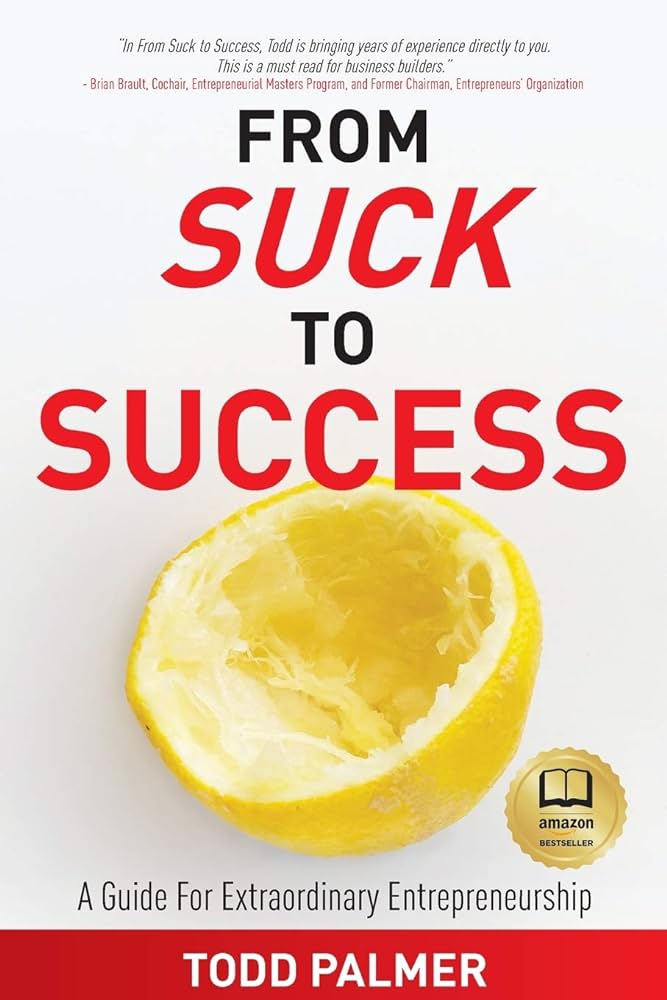
Over the past year, I've noticed an interesting trend among entrepreneurs. Whenever business becomes uncertain, margins tighten, or growth slows down, everyone starts looking for a new system.
"We need EOS."
"We should implement Scaling Up."
"We need better SOPs."
"We need another dashboard."
Don't misunderstand me—I like every one of those tools. I've recommended EOS. I've recommended Scaling Up. I believe in scorecards, accountability charts, KPIs, and documented processes. Systems matter. They bring clarity, consistency, and accountability to growing organizations. I've seen them transform businesses.
I've also seen them fail spectacularly.
The difference was almost never the framework.
It was whether the leader was willing to let the framework expose their own blind spots.
After coaching entrepreneurs for more than nine years, I've learned something that isn't nearly as popular.
Most businesses don't have a systems problem.
They have a leadership problem.
The system isn't broken.
The leader/entrepreneur is avoiding the work the system is exposing.
I know this because I lived it.
Back in 2004 and 2005, my staffing company was struggling. We were losing money, customers were leaving, employees were frustrated, and I convinced myself the answer was another process, another report, another organizational chart, or another management meeting. I blamed the economy. I blamed difficult customers. I blamed employees who "just didn't care enough."
Looking back, every one of those explanations allowed me to avoid looking in the mirror.
The real problem wasn't a lack of systems.
The real problem was me.
That wasn't an easy realization. As entrepreneurs, we like fixing businesses because businesses don't argue back. Looking in the mirror is different. The mirror doesn't let us blame the economy, our employees, or our customers. It simply asks one uncomfortable question:
What if you're the bottleneck?
I wasn't having the difficult conversations that needed to happen. I wasn't holding people accountable consistently. I was not disciplined enough to be focused on revenue-generating activities to turn the business around. I wasn't protecting the business the way a CEO should. Instead, I convinced myself that if I could just find the perfect operating system, everything else would magically fall into place.
It never did.
What I've come to realize is that systems are incredibly effective at exposing leadership gaps, but they're terrible at fixing them. A scorecard can tell you a problem exists. An accountability chart can clarify who owns it. An SOP can explain how the work should be done.
None of those things can make a leader courageous enough to have the conversation they've been avoiding for six months. And, more often than not, the first conversation starts with yourself.
That's the work.
So why do so many smart entrepreneurs hide behind systems instead of doing the real leadership work?
Because writing an SOP doesn't reject us.
A dashboard doesn't argue with us.
A process doesn't tell us we're wrong.
Difficult conversations do.
A coach giving us hard feedback does.
Holding someone accountable does.
Systems feel objective.
Leadership feels personal. Because it is.
When we're under stress, our brains naturally gravitate toward what feels emotionally safer. We'd rather spend three hours redesigning a workflow than spend thirty uncomfortable minutes telling a high performer that they're damaging the culture. One activity feels productive. The other feels risky.
Organizational psychologist Chris Argyris described this as defensive reasoning—our tendency to solve the visible problem while unconsciously protecting ourselves from confronting the real one. In business, that often means redesigning processes instead of changing our behaviors. We stay busy improving systems because it's far less uncomfortable than improving ourselves.
I've watched entrepreneurs spend months perfecting SOPs while avoiding a twenty-minute conversation with the employee who is undermining the culture. I've seen leadership teams debate KPI dashboards for hours while refusing to address the lack of trust around the conference table. I've watched CEOs invest tens of thousands of dollars implementing operating systems that they themselves refuse to follow consistently.
Eventually, the team notices.
When leaders ignore the very disciplines they ask everyone else to follow, the message is clear: the process isn't important. The leader's behavior always becomes the culture.
Patrick Lencioni has written that organizational health is built on trust, clarity, accountability, and healthy conflict. Notice that none of those begin with software or systems. They begin with leadership. Systems support healthy leadership, but they can never replace it.
Amy Edmondson's research on psychological safety reaches a similar conclusion. Employees take their cues from leader behavior far more than they do from policies or procedures. If the leader avoids difficult conversations, the team learns to avoid them. If the leader refuses accountability, accountability quietly disappears throughout the organization.
I call this the Avoid-Dance.
Every week you delay a difficult conversation, you're paying interest on it. Productivity drops. Trust erodes. Your best employees become frustrated. Your customers eventually feel it. Avoidance is one of the most expensive line items on an entrepreneur's P&L, even though it never appears on the financial statements.
That's why I believe entrepreneurs often ask the wrong question.
Instead of asking, "What system do we need?"
A better question might be, "What leadership responsibility am I hoping this new system will save me from?"
That's a much harder question to answer.
It's also the one that usually unlocks growth.
The irony is that most entrepreneurs already know exactly what needs to happen. They know which employee they're avoiding. They know which customer conversation they've been putting off. They know the financial reports they haven't looked at. They know the promises they've made to themselves that they've quietly broken.
The issue usually isn't information.
The issue is avoidance.
And avoidance has a funny way of disguising itself as productivity.
Creating another spreadsheet feels productive.
Building another dashboard feels productive.
Holding another planning session feels productive.
Sometimes those things are exactly what's needed.
Other times, they're simply procrastination wearing a business suit.
I've learned that businesses rarely outgrow the courage of their leaders. Systems help businesses scale, but only after leaders become willing to let those systems expose their own blind spots instead of hiding behind them.
Most entrepreneurs don't need another operating system.
They need a new operating system between their ears.
So before you invest in another framework, another consultant, or another beautifully designed operating system, spend a few quiet minutes asking yourself one uncomfortable question:
What leadership conversation am I hoping this new system will save me from having?
If that question makes you uncomfortable, don't run from it.
You're probably standing at the exact place where your business is waiting for you to grow.
Because in my experience, the next level of your business is almost never hiding inside another manual.
It's waiting in the mirror.